
NORTHSTARCOMMERCE
A Shopify storefront for a confidential DTC brand, built around a live connection to an external supplier system for product, pricing and inventory data.
Client
Northstar Commerce
Confidential DTC / Dropshipping Brand
Services
- E-Commerce Development
- Shopify Development
- API Integration
- Custom System Integration
- Real-Time Inventory & Pricing
- Product Data Automation
- Order Integration
- Creative Technology
ONE STOREFRONT.TWO SYSTEMS.ONE CONNECTEDCOMMERCE FLOW.
The client operated their own Shopify storefront while sourcing products through an external supplier ecosystem. We built the integration layer that connected both systems — allowing products to move into Shopify while keeping critical pricing and inventory information tied to the external source.
Product Data
Products and catalog information were pulled from the supplier system, structured and prepared for the client's Shopify storefront.
Live Validation
Price and inventory were checked against the external system at the critical point of purchase.
Connected Order Flow
Customers remained inside the client's Shopify shopping experience while the external supplier/data system worked behind the scenes.
The Challenge
The client needed a Shopify storefront built around products sourced through an external supplier ecosystem. The challenge went beyond importing a product catalog — Shopify and the supplier's system were two independent platforms with their own data and workflows, and the storefront needed to reflect the supplier's latest pricing and inventory the moment a customer was ready to order.
The Solution
We engineered a custom integration between Shopify and the external supplier system. Products were sourced, transformed into Shopify-compatible data, and published to the client's storefront. At the point of purchase, the integration validated current stock and pricing against the external source before the order proceeded — so the store behaved like an ordinary Shopify experience on the surface, while a connected data workflow ran underneath.
What We Built
- 01
Product Sync
Product and catalog information was sourced from SRP, transformed and published into the client's Shopify storefront.
- 02
Live Inventory Validation
Inventory availability was checked against the external SRP system rather than relying solely on static Shopify inventory data.
- 03
Live Pricing
Current supplier-side pricing was retrieved and validated before order execution to reduce the risk of outdated pricing.
- 04
Order Integration
The Shopify order workflow was connected with the external product/fulfillment ecosystem so the transaction could continue into the supplier-side process.
- 05
Custom Shopify Experience
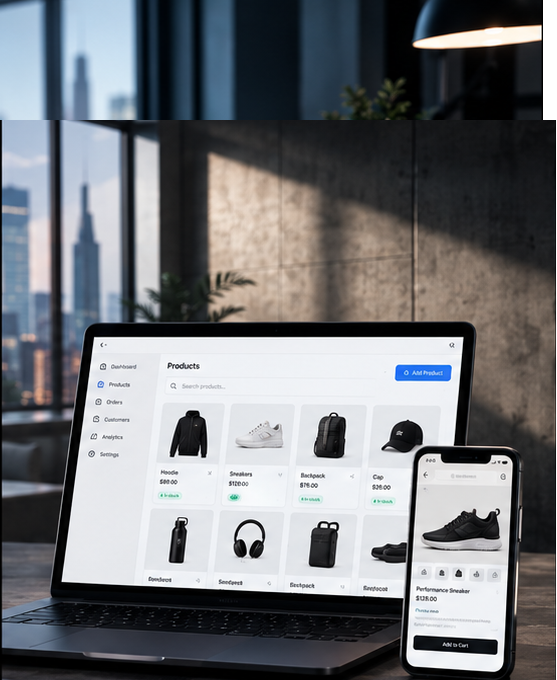
A custom storefront was built around product discovery, collections and conversion while hiding the underlying system complexity from customers.
- 06
Responsive Commerce
The complete storefront experience was optimized across desktop, tablet and mobile.
Gallery
The Technical Challenge
The hard part wasn’t Shopify. It was making two independent systems act like one.
The storefront itself was only one part of the problem. The client was selling through Shopify, while critical product information lived in an external SRP system — two platforms never designed to feel like one unified commerce layer.
- Products needed to move into Shopify.
- Inventory couldn't simply be treated as static data.
- Pricing needed to be validated against the external source.
- And the customer's Shopify experience had to remain simple and uninterrupted.
The integration had to coordinate product synchronization, external server communication, live inventory and pricing validation, order processing and failure handling — all without exposing the complexity to the customer.
Integration had to handle
- Product synchronization
- API / external server communication
- Product data transformation
- Live inventory validation
- Live pricing validation
- Order integration
- Error and availability handling
- Shopify order workflow
- Customer-facing Shopify experience
Why This Was Different
This wasn’t a conventional Shopify product import.
A typical integration can synchronize products once and leave Shopify to manage the rest. Here, Shopify was the customer-facing commerce layer while the external SRP system remained a critical source of product, pricing and inventory information.
We effectively created a connected commerce layer between the two systems — allowing the client to operate their own storefront without manually recreating the supplier ecosystem inside Shopify.
The Result
A Shopify storefront that allowed the client to sell products sourced through the SRP ecosystem under their own customer-facing brand, while maintaining a live connection to the external data required for reliable order execution.
Key Outcomes
- One customer-facing Shopify storefront connected to an external supplier ecosystem
- Product data brought from the supplier system into Shopify automatically
- Pricing and inventory validated against live external data at the point of purchase
- Reduced dependency on manually maintained product information
- A seamless customer experience despite a complex multi-system backend
- A scalable foundation for a supplier-connected dropshipping operation
One storefront. Two systems. One connected commerce experience.